Findings: not really
Over half of your libraries are used by fewer than 0.1% of your executables.
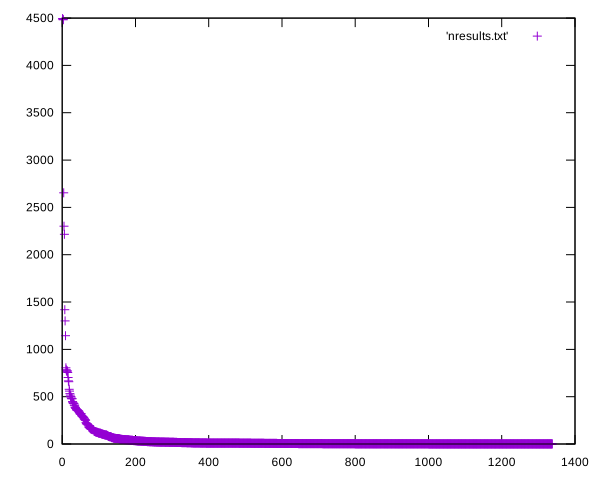 Number of times each dynamic library is required by a program
libs.awk
		/\t.*\.so.*/ {
			n=split($1, p, "/")
			split(p[n], l, ".")
			lib=l[1]
			if (libs[lib] == "") {
				libs[lib] = 0
			}
			libs[lib] += 1
		}
		END {
			for (lib in libs) {
				print libs[lib] "\t" lib
			}
		}
Usage
		$ find /usr/bin -type f -executable -print \
			| xargs ldd 2>/dev/null \
			| awk -f libs.awk \
			| sort -rn > results.txt
		$ awk '{ print NR "\t" $1 }' < results.txt > nresults.txt
		$ gnuplot
		gnuplot> plot 'nresults.txt'
		$ find /usr/bin -type f -executable -print | wc -l
		5688
		$ head -n20 < results.txt
		4496	libc
		4484	linux-vdso
		4483	ld-linux-x86-64
		2654	libm
		2301	libdl
		2216	libpthread
		1419	libgcc_s
		1301	libz
		1144	libstdc++
		805	liblzma
		785	librt
		771	libXdmcp
		771	libxcb
		771	libXau
		755	libX11
		703	libpcre
		667	libglib-2
		658	libffi
		578	libresolv
		559	libXext
Findings: definitely not
| Linkage | Avg. startup time |
|---|---|
| Dynamic | 137263 ns |
| Static | 64048 ns |
ex.c
		#include <stdio.h>
		#include <stdlib.h>
		#include <time.h>
		#include <unistd.h>

		int main(int argc, char *argv[]) {
			struct timespec ts;
			clock_gettime(CLOCK_MONOTONIC, &ts);
			fprintf(stdout, "%ld\t", ts.tv_nsec);
			fflush(stdout);
			if (argc == 1) {
				char *args[] = { "", "", NULL };
				execvp(argv[0], args);
			} else {
				fprintf(stdout, "\n");
			}
			return 0;
		}
test.sh
		#!/bin/sh
		i=0
		while [ $i -lt 1000 ]
		do
			./ex
			i=$((i+1))
		done
My results
		$ musl-gcc -o ex ex.c
		$ ./test.sh | awk 'BEGIN { sum = 0 } { sum += $2-$1 } END { print sum / NR }'
		137263
		$ musl-gcc -static -o ex ex.c
		$ ./test.sh | awk 'BEGIN { sum = 0 } { sum += $2-$1 } END { print sum / NR }'
		64048
Findings: not really
On average, dynamically linked executables use only 4.6% of the symbols on offer from their dependencies. A good linker will remove unused symbols.
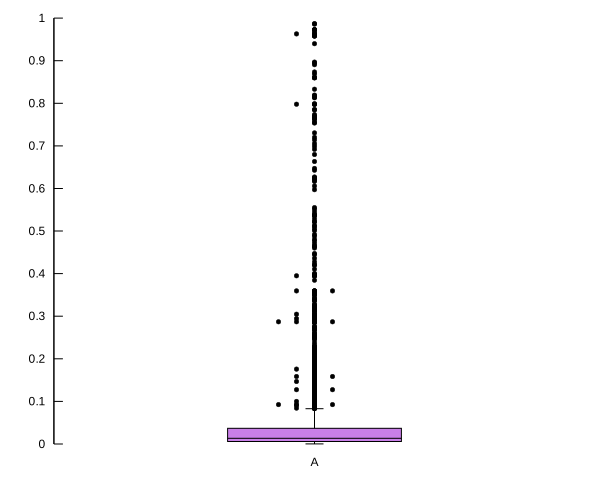 % of symbols requested by dynamically linked programs from the libraries that it depends on
nsyms.go
		package main

		import (
			"bufio"
			"fmt"
			"os"
			"os/exec"
			"path/filepath"
			"strings"
		)

		func main() {
			ldd := exec.Command("ldd", os.Args[1])
			rc, err := ldd.StdoutPipe()
			if err != nil {
				panic(err)
			}
			ldd.Start()

			var libpaths []string
			scan := bufio.NewScanner(rc)
			for scan.Scan() {
				line := scan.Text()[1:] /* \t */
				sp := strings.Split(line, " ")
				var lib string
				if strings.Contains(line, "=>") {
					lib = sp[2]
				} else {
					lib = sp[0]
				}
				if !filepath.IsAbs(lib) {
					lib = "/usr/lib/" + lib
				}
				libpaths = append(libpaths, lib)
			}
			ldd.Wait()
			rc.Close()

			syms := make(map[string]interface{})
			for _, path := range libpaths {
				objdump := exec.Command("objdump", "-T", path)
				rc, err := objdump.StdoutPipe()
				if err != nil {
					panic(err)
				}
				objdump.Start()
				scan := bufio.NewScanner(rc)
				for i := 0; scan.Scan(); i++ {
					if i < 4 {
						continue
					}
					line := scan.Text()
					sp := strings.Split(line, " ")
					if len(sp) < 5 {
						continue
					}
					sym := sp[len(sp)-1]
					syms[sym] = nil
				}
				objdump.Wait()
				rc.Close()
			}

			objdump := exec.Command("objdump", "-R", os.Args[1])
			rc, err = objdump.StdoutPipe()
			if err != nil {
				panic(err)
			}
			objdump.Start()
			used := make(map[string]interface{})
			scan = bufio.NewScanner(rc)
			for i := 0; scan.Scan(); i++ {
				if i < 5 {
					continue
				}
				sp := strings.Split(scan.Text(), " ")
				if len(sp) < 3 {
					continue
				}
				sym := sp[len(sp)-1]
				used[sym] = nil
			}
			objdump.Wait()
			rc.Close()

			if len(syms) != 0 && len(used) != 0 && len(used) <= len(syms) {
				fmt.Printf("%50s\t%d\t%d\t%f\n", os.Args[1], len(syms), len(used),
					float64(len(used)) / float64(len(syms)))
			}
		}
Usage
		$ find /usr/bin -type f -executable -print | xargs -n1 ./nsyms > results.txt
		$ awk '{ n += $4 } END { print n / NR }' < results.txt
Findings: not really
Not including libc, the only libraries which had "critical" or "high" severity vulnerabilities in 2019 which affected over 100 binaries on my system were dbus, gnutls, cairo, libssh2, and curl. 265 binaries were affected by the rest.
The total download cost to upgrade all binaries on my system which were affected by CVEs in 2019 is 3.8 GiB. This is reduced to 1.0 GiB if you eliminate glibc.
It is also unknown if any of these vulnerabilities would have been introduced after the last build date for a given statically linked binary; if so that binary would not need to be updated. Many vulnerabilities are also limited to a specific code path or use-case, and binaries which do not invoke that code path in their dependencies will not be affected. A process to ascertain this information in the wake of a vulnerability could be automated.
extractcves.py
		import email.utils
		import mailbox
		import re
		import shlex
		import time

		pacman_re = re.compile(r'pacman -Syu .*')
		severity_re = re.compile(r'Severity: (.*)')

		mbox = mailbox.mbox("arch-security.mbox")
		for m in mbox.items():
				m = m[1]
				date = m["Date"]
				for part in m.walk():
						if part.is_multipart():
								continue
						content_type = part.get_content_type()
						[charset] = part.get_charsets("utf-8")
						if content_type == 'text/plain':
								body = part.get_payload(decode=True).decode(charset)
								break
				pkgs = pacman_re.findall(body)
				severity = severity_re.findall(body)
				date = email.utils.parsedate(date)
				if len(pkgs) == 0 or date is None:
						continue
				if date[0] <= 2018 or date[0] > 2019:
						continue
				severity = severity[0]
				args = shlex.split(pkgs[0])
				pkg = args[2].split(">=")[0]
				print(pkg, severity)
		$ python3 extractcves.py | grep Critical > cves.txt
		$ xargs pacman -Ql < cves.txt | grep \\.so | awk '{print $1}' | sort -u>affected.txt
		# Manually remove packages like Firefox, Thunderbird, etc; write remainder.txt
		$ xargs pacman -Ql < remainder.txt | grep '/usr/lib/.*.so$' | awk '{ print $2 }' > libs.txt
		$ ldd /usr/bin/* >ldd.txt
		$ ./scope.sh <libs.txt | sort -nr >sobjects.txt
sobjects.txt is a sorted list of shared objects and the number of executables that link to them. To find the total size of affected binaries, I ran the following command:
		# With libc
		$ egrep -la 'libc.so|libm.so|libdl.so|libpthread.so|librt.so|libresolv.so|libdbus-1.so|libgnutls.so|libcairo.so|libutil.so|libssh2.so|libcurl.so|libcairo-gobject.so|libcrypt.so|libspice-server.so|libarchive.so|libSDL2-2.0.so|libmvec.so|libmagic.so|libtextstyle.so|libgettextlib-0.20.2.so|libgettextsrc-0.20.2.so|libMagickWand-7.Q16HDRI.so|libMagickCore-7.Q16HDRI.so|libbfd-2.34.0.so|libpolkit-gobject-1.so|libwebkit2gtk-4.0.so|libjavascriptcoregtk-4.0.so|libpolkit-agent-1.so|libgs.so|libctf.so|libSDL.so|libopcodes-2.34.0.so|libQt5WebEngine.so|libQt5WebEngineCore.so|libctf-nobfd.so|libcairo-script-interpreter.so' /usr/bin/* | xargs wc -c
		# Without libc
		$ egrep -la 'libdbus-1.so|libgnutls.so|libcairo.so|libssh2.so|libcurl.so|libcairo-gobject.so|libcrypt.so|libspice-server.so|libarchive.so|libSDL2-2.0.so|libmvec.so|libmagic.so|libtextstyle.so|libgettextlib-0.20.2.so|libgettextsrc-0.20.2.so|libMagickWand-7.Q16HDRI.so|libMagickCore-7.Q16HDRI.so|libbfd-2.34.0.so|libpolkit-gobject-1.so|libwebkit2gtk-4.0.so|libjavascriptcoregtk-4.0.so|libpolkit-agent-1.so|libgs.so|libctf.so|libSDL.so|libopcodes-2.34.0.so|libQt5WebEngine.so|libQt5WebEngineCore.so|libctf-nobfd.so|libcairo-script-interpreter.so' /usr/bin/* | xargs wc -c
No.
We've had ASLR for statically linked binaries for some time now. It's called static PIE.